About the Client
The client is an online flooring retailer with its own showroom in Mesa, AZ, that ships nationwide. It sells engineered hardwood, waterproof luxury vinyl, waterproof laminate, and tile from major manufacturers at wholesale prices, shipped directly from the manufacturer to homeowners, contractors, and designers. We designed and built its Shopify store to sell flooring by the carton.
Most orders cover whole rooms or homes, so a typical sale runs into the thousands of dollars. Buyers compare materials, brands, and prices across several sites before they commit, and many request an itemized estimate or call before ordering. The store’s own customer reviews describe the hurdle clearly: several buyers say they were skeptical about ordering flooring online from a store they had never visited.
Goal
Turn organic search into a consistent source of estimate requests, qualified leads, and orders from buyers across the U.S., reducing the business’s reliance on paid acquisition and creating a channel that can compound over time.
A key objective was to reduce dependence on Google Ads and increase the share of customers attributed to organic search, allowing the business to generate more demand without paying for every click.
The Situation and Challenges
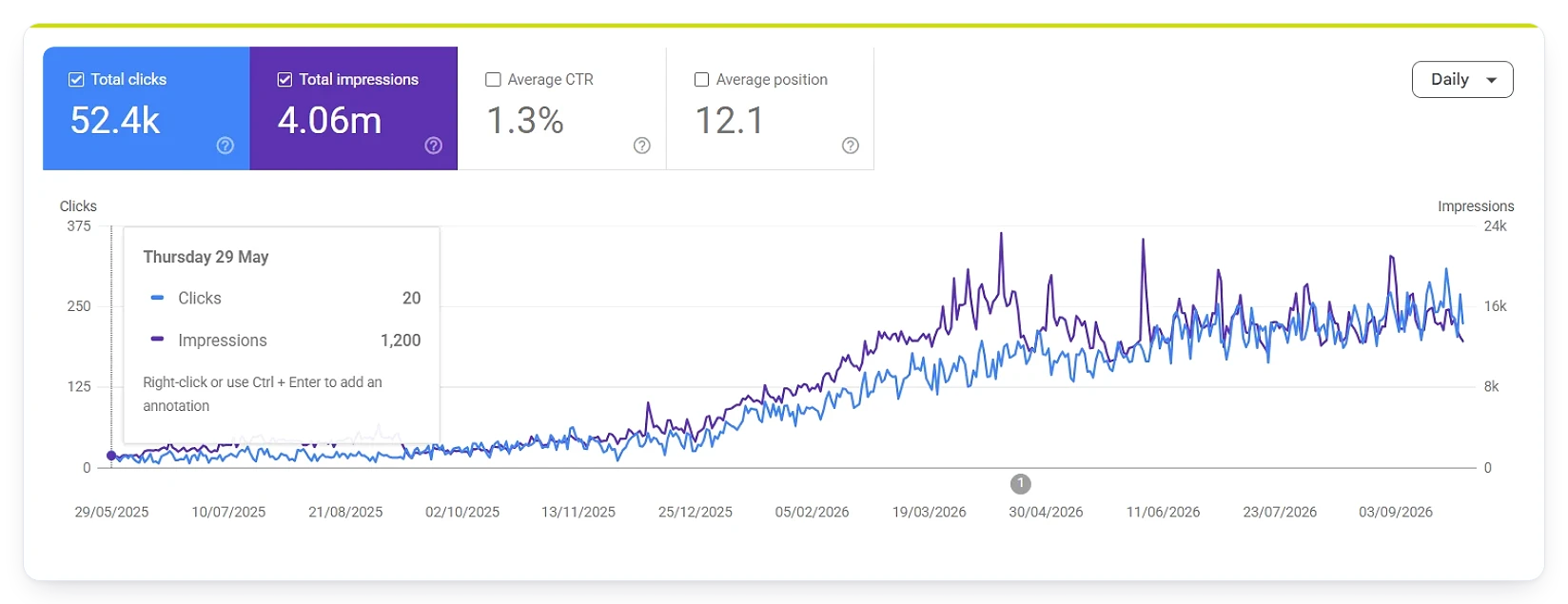
When monthly SEO began in May 2025, the store had almost no search visibility. Search Console showed fewer than 20 clicks a day, and Semrush tracked roughly 630 ranking keywords.
Beyond rankings, the store lacked several foundational elements needed to compete in a highly competitive flooring market. The website was not structured around strong commercial verticals that matched how customers search for flooring, limiting its ability to capture high-intent traffic across materials, rooms, brands, and buying stages.
The brand also needed stronger trust signals through design, messaging, and user experience. For a high-value purchase like flooring, customers need confidence before requesting an estimate or placing an order, and the website didn’t fully communicate the business’s credibility, expertise, and value.
The site also lacked topical authority. Existing content did not sufficiently cover the questions, comparisons, and buying decisions customers research before purchasing flooring, making it harder for Google to recognize the brand as a reliable industry resource.
Conversion rate optimization was another missing piece. Collection and product pages attracted potential buyers, but the user journey wasn’t fully optimized to convert that traffic into estimate requests, inquiries, and sales. Without stronger conversion paths and trust elements, valuable organic visitors were more likely to leave without taking action.
Here are the baseline metrics:
- <20 daily organic clicks
- ~630 ranking keywords
Three things made the market hard to break into:
- Heavy competition. Flooring searches are dominated by big-box home improvement chains, national flooring retailers, and the manufacturers’ own websites.
- Shared product content. Retailers selling the same floors tend to use the same manufacturer descriptions, so a new store starts with product pages that look like thousands of others to Google.
- Trust in buying flooring online. A four-figure order from an unfamiliar online store is a big ask, and the site had to earn that trust before a buyer would call or request an estimate.
The Strategy
We ran the account as a monthly program across eight workstreams, with work shipping every month from May 2025 onward and reporting through a live dashboard.
1. Tracking and Keyword Research First
We started by setting up GA4 through Google Tag Manager and building a Looker Studio dashboard so we could measure every result from day one. Keyword research then mapped search demand to the store’s materials, use cases, and brands. Every later workstream drew its targets from that map.
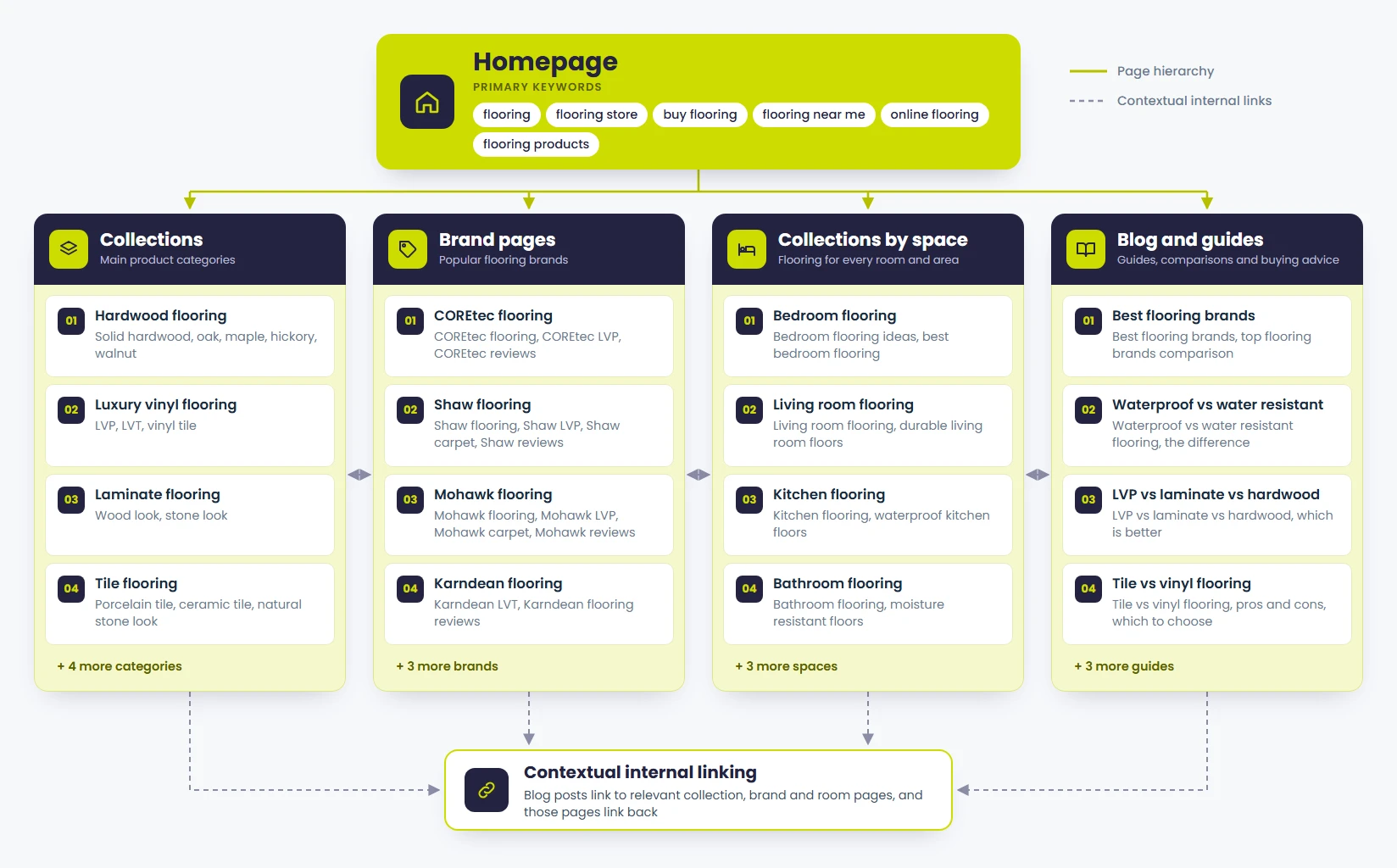
We created a keyword-driven silo structure designed around how flooring customers search and make purchasing decisions. The homepage targeted broad commercial terms, while collection pages focused on high-intent flooring categories such as hardwood, carpet, luxury vinyl, and tile.
Brand pages captured users searching for specific manufacturers, while supporting blog content targeted informational searches around installation, maintenance, comparisons, and buying decisions.
2. Collection Pages as the Main Ranking Engine
For a flooring store, collection pages target many of the high-intent searches that can lead to product discovery, estimates, and orders, such as material, room, and brand searches. We optimized more than 160 collection pages over 16 months, usually 10 a month and 19 in June 2025, along with 11 brand pages.
In August 2025, we ran a gap analysis to find the collections the store was missing. The store now organizes flooring by material, room, and brand, giving buyers multiple paths to find relevant products based on how they search.
Here’s what we did:
- Optimized titles and descriptions around the primary search intent and keyword targets for each collection.
- Refined product cards, pricing visibility, trust signals, and CTAs to make product discovery and purchase decisions easier.
- Added 500–700 words of useful, search-focused copy to provide context around the flooring category without getting in the way of product discovery.
- Answered common buyer questions in a concise format designed to support both traditional search and AI-powered discovery.
- Added relevant schema markup to help search engines better understand collection and product relationships.
- Used gap analysis to identify missing categories and create new opportunities around high-value searches.
- Connected related collections, brands, products, and supporting content to create clearer paths for both users and crawlers.
3. Product Page Optimization
We optimized 20 product pages in the first three months and ran a product SEO test in July 2025. From September 2025, product optimization became a monthly workstream, so each product page could rank for its own specific searches.
Here’s what we did:
- Reworked title tags and meta descriptions around relevant product and search terms.
- Expanded image galleries with different product views and real-world use cases to build shopper confidence.
- Made pricing information and MOQs easier to find and understand.
- Added clearer paths for visitors to request estimates and move toward a purchase.
- Highlighted reassurance points such as the Best Price Guaranteed message.
- Targeted specific product-level queries instead of relying solely on broad category keywords.
- Combined product information, pricing, imagery, and conversion elements so pages served both search engines and users.
4. E-E-A-T & Personal Branding
We found that the business owner drove the company and personally handled customer relationships, product questions, and pre-sale conversations. Rather than treating this as a hidden asset, we made the owner’s real-world expertise part of the SEO strategy.
We used his 10+ years of flooring experience to strengthen the website’s experience and trust signals while giving potential customers a clear connection to the person behind the business. This helped position the site as a resource backed by someone with genuine industry knowledge, not just another flooring retailer publishing generic content.
Here’s what we did:
- Used his credentials, experience, and role in relevant CTAs and conversion points so visitors knew they could speak directly with an industry expert.
- Created an author bio highlighting his 10+ years of flooring experience, practical knowledge, and involvement in the business.
- Used consistent author attribution across relevant educational content to clearly connect the information to the person with firsthand industry experience.
- Encouraged the owner to create practical videos that answer common flooring questions, compare materials, and share real-world recommendations.
- Focused content on practical insights, customer questions, product considerations, and real flooring scenarios rather than generic information available across competing websites.
- Integrated the owner’s knowledge into informational and commercial pages so users could move from researching a flooring question to getting advice from someone who actually works in the industry.
Our goal was to make the website feel backed by a flooring expert customers could actually talk to, not an anonymous content machine.
5. Content That Answers Flooring Buyers’ Questions
Our content strategy was built around a simple principle: we did not want to publish broad informational articles that attract traffic but leave without creating a business opportunity. We selected each topic and content angle as an entry point into a specific flooring choice, problem, comparison, or solution that could naturally lead the reader toward a product or collection.
We published more than 45 blog posts built around the questions buyers ask before choosing or ordering flooring. This included “best brands” guides for laminate, engineered hardwood, and luxury vinyl, with each guide connecting readers directly to the relevant collections. The content was designed to help users make a decision while creating a natural path from search → education → product discovery → estimate or purchase.
We also used personal branding and strategically placed CTAs throughout. Instead of ending the reader’s journey with an informational answer, relevant articles gave visitors a reason to continue, whether that meant exploring a recommended flooring collection, requesting an estimate, or getting advice from the business owner. This helped turn informational search traffic into potential commercial opportunities.
One basement flooring guide now ranks on the first page of Google for more than 50 basement-related searches and is cited in Google’s AI Overview for many of them.
Existing content received the same level of attention as new content. An interlinking and content gap analysis in November 2025 identified missing topics and weak connections between existing articles. A quality pass in February 2026 rewrote weaker content and strengthened internal linking, followed by further reoptimization of older posts in March 2026. In September 2026, we added a brand story article to strengthen the connection between the content, the business, and the expertise behind it.
The engineered hardwood brands guide demonstrates how this approach compounds over time. A year earlier, it was buried between positions four and ten for its target searches. It now ranks in the top five for more than 30 target queries, giving the business both broader search visibility and more opportunities to bring high-intent flooring shoppers into the buying journey.
6. Honest Brand Reviews, Downsides Included
Retailers rarely say anything negative about the brands they sell. We took the opposite approach. For a series covering nine major flooring brands, every review includes a section on that brand’s known problems.
It was a real risk, since telling buyers what can go wrong with a product the store sells could cost a sale. We made the call because buyers researching a four-figure order already know every brand has weaknesses, and a retailer that admits them earns trust a sales page cannot. The review pages now rank on the first page of Google for their brand review searches, including second place for “coretec flooring reviews.”
The same approach carries into a guide to the worst vinyl plank flooring brands, which now ranks first on Google for “worst vinyl plank flooring brands” and is cited in Google’s AI Overview for the same search.
7. Authority Building Through Links and Guest Posts
A new store needs other websites vouching for it. We built 30 contextual backlinks between May and July 2025 and placed about 35 guest posts on relevant sites over the engagement, with off-page work continuing every month.
8. Technical SEO and Site Health
We ran two full audit sprints in July and August 2025 and fixed more than a dozen issue categories. These included duplicate and conflicting canonical tags; duplicate or identical H1 and title tags; missing, duplicate, and overlong meta descriptions; titles outside the ideal length; broken internal and external links; 404 errors; links pointing to redirects; broken images; and images without alt text.
We added Organization and FAQ schema, submitted crawled but unindexed pages for indexing, and followed up with Search Console and Semrush fixes through late 2025. Monthly on-page, technical, and store maintenance work continues.
9. Local and Landing Pages
The store has dedicated pages for its home state and its largest cities. From May 2026, we wrote and designed new landing pages, adding three more in July and August and three in September. We also manage the store’s Google Business Profile, which now holds more than 50 five-star reviews.
10. Paid Search, Shopping and Pinterest Alongside SEO
We manage the store’s Google Ads and Merchant Center feed every month, so its products appear in Shopping results while organic rankings build. Pinterest marketing runs monthly as well, putting flooring styles in front of homeowners planning a project. A design update in September 2025 refreshed the store as it grew.
11. Building Visibility Across AI Search
We treated AI visibility as an extension of the broader SEO strategy, not as a separate content exercise. The goal was to make the business, products, brands, and expertise easier for both search engines and AI systems to understand, retrieve, and reference.
We strengthened the site for emerging AI discovery by improving entity clarity, topical coverage, structured data, internal linking, product and brand information, and first-hand expertise. We also explored technical AI-readiness elements such as llms.txt, clearer machine-readable content, and site structures that support agentic browsing and retrieval, making important business and product information easier for AI-powered systems to navigate.
Content was also developed around specific buyer questions, comparisons, product choices, and flooring problems rather than broad informational topics. This gave AI systems more useful, context-rich sources to draw from when users asked for flooring recommendations, brand comparisons, product options, and solutions to specific flooring needs.
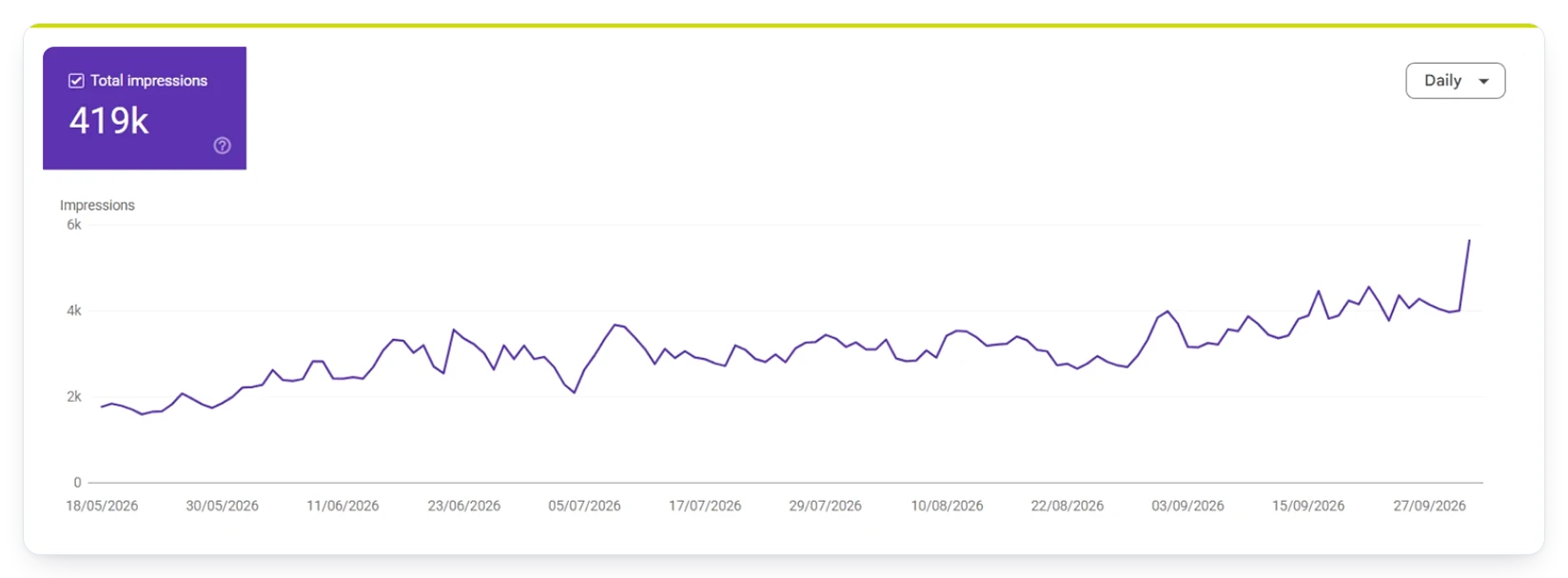
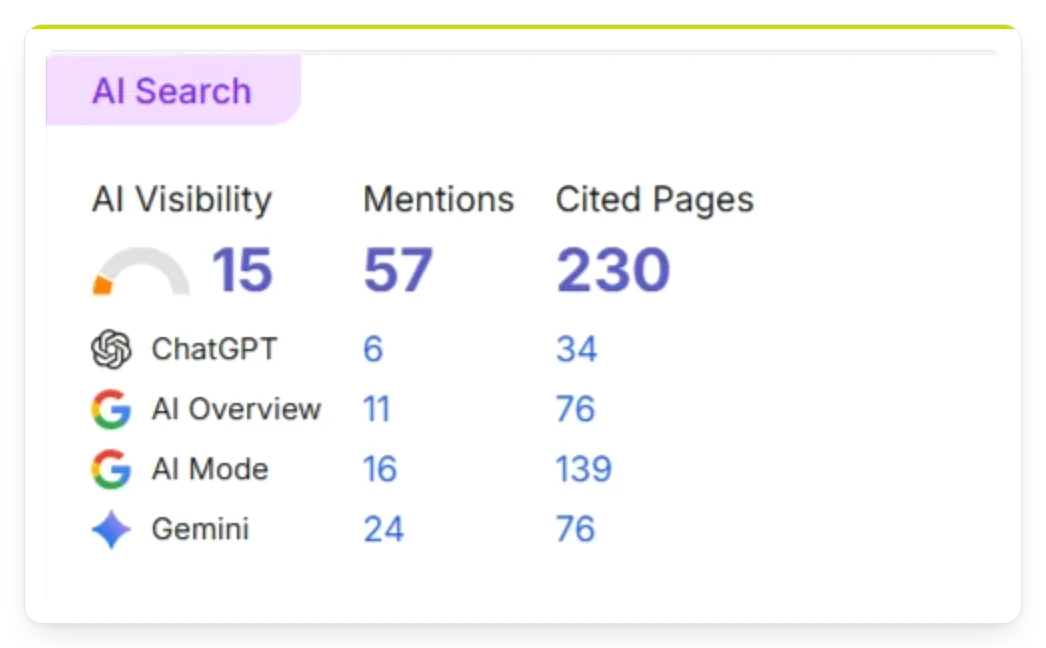
In GSC’s Generative AI reporting, daily impressions increased from 1,766 to 5,631, a 219% increase. SEMrush also reports 57 AI mentions and 230 cited pages across ChatGPT, AI Overviews, AI Mode, and Gemini.
Results
Search performance (full site, GSC data):
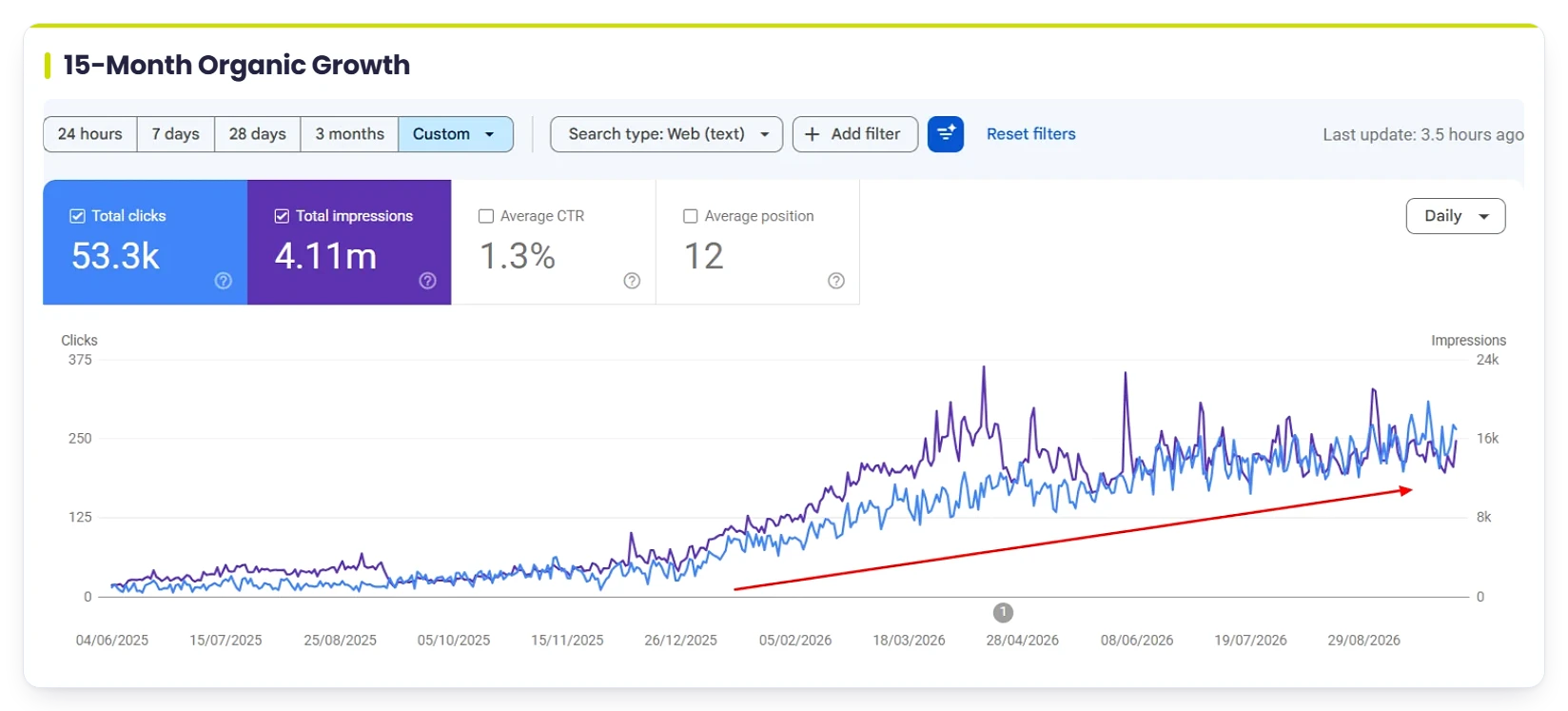
- 53.3k organic clicks
- 4.11m impressions
- 1.3% average CTR
- 12 average position
Daily organic clicks increased from 15 to 309, a 1,960% increase.
Blog performance (same period):

- 32.2k organic clicks
- 2.62m impressions
- 1.2% average CTR
- 10.6 average position
Collections performance (same period):

- 4.85k organic clicks
- 685k impressions
- 0.7% average CTR
- 16.4 average position
Products performance (same period):

- 15.4k organic clicks
- 882k impressions
- 1.8% average CTR
- 11.9 average position
Traffic insights

- 89% of clicks came from the U.S.
- 100% of reported clicks were classified as non-branded
For the first six months, results built slowly. Between May and October 2025, we shipped 30 contextual backlinks, about 35 guest posts, around 60 collection pages, and 22 blog posts, and clicks grew steadily from a small base. From December 2025, the curve turned sharply upward. Daily clicks passed 100 in early 2026 and regularly topped 200 by the summer.
AI search visibility
- In GSC, Generative AI, daily impressions increased from 1,766 to 5,631, a 219% increase.
- SEMRush reports 57 AI mentions and 230 Cited Pages across ChatGPT, AI Overviews, AI Mode, and Gemini.
Leads
- 27,445.5 Google Ads Conversions
- $59,316 Total Sales
- $63,226 Gross Sales
- 18 Orders
- 138 Phone Calls from Ads
- 859 Quote Form Submissions
- 1160 Call Button Clicks
- 27 Contact Form Submissions
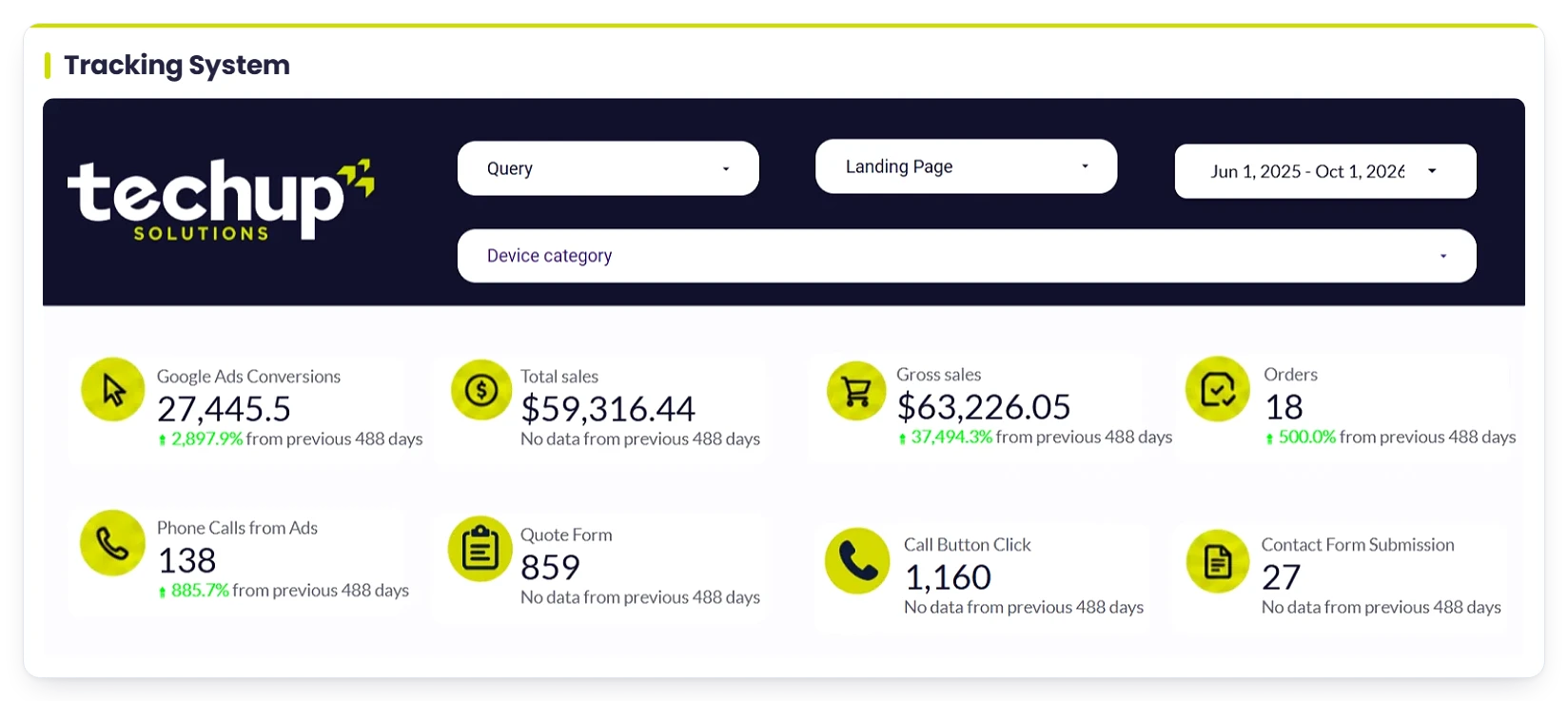
Note: The primary conversion process remained email conversations between the business owner and prospective customers. As a result, purchases completed through email or direct contact are not included in the tracked data.
The ROI
- The client invested $16.9K in SEO & Ads services over 16 months.
The client invested $16.9K in SEO and Ads over 16 months. The tracked data attributed $63.2K+ in gross sales during the reporting period, representing a 3.74x revenue-to-spend multiple.
NOTE: This figure represents tracked sales only. Purchases completed through email or direct contact were not included in the attribution data.
Next Moves?
- Since the business ships in all 50 U.S. states, our next move is to improve local proximity across all states and cities beyond the home state.
- Keep building silos for collection pages, including material-based collections, brands, and spaces.
- Earn more visibility in AI answers. Honest brand reviews are the kind of content AI search tools cite, so we will extend the series and track AI Overview appearances alongside rankings.
- Connect organic traffic to estimates. Report organic-sourced estimate requests every month so SEO results count toward revenue.
- Leverage Reddit organic marketing for brand awareness, lead generation, and AI visibility.
Ready to Turn Organic Search Into More Sales?
If your store has strong products but buyers keep finding your competitors first, we can help you close that gap. Book a strategy call, and we’ll show you what’s holding your organic search back.