
About the Client
It’s a family-owned flooring and remodeling business serving the Pacific Northwest since 1990, with showrooms in Bellevue and Redmond, WA.
The business combines product sales, design consultation, installation, repair, and remodeling under one roof. Customers can shop flooring from multiple manufacturers and also get help with cabinetry, countertops, custom rugs, wallpaper, paint, hardwood refinishing, and complete kitchen and bathroom remodels.
What They Offer:
- Flooring & Products: Carpet, hardwood, tile, luxury vinyl, laminate, waterproof flooring, custom rugs, cabinetry, countertops, wallpaper, and paint.
- Flooring Services: Installation, hardwood refinishing, repair, design consultation, and related flooring services.
- Remodeling: Kitchen, bathroom, and broader home remodeling projects.
Local Presence:
The company operates two physical showrooms in Bellevue and Redmond and serves customers within approximately a 30 km radius of its locations.
Its service area includes communities such as Bellevue, Redmond, Seattle, Kirkland, Renton, Kent, Federal Way, Issaquah, Sammamish, Bothell, Woodinville, Shoreline, Lynnwood, Edmonds, Mercer Island, and surrounding areas.
How Customers Buy:
The business essentially operates across two connected verticals:
- Shopping: Customers research flooring, explore products and manufacturers, visit the showroom, request measurements or estimates, and take samples home before buying.
- Services: Customers can also work with the business for installation, hardwood refinishing, custom rugs, kitchen remodeling, bathroom remodeling, wallpaper, and other home improvement needs.
This makes it more than a flooring retailer. It is positioned as a one-stop showroom for flooring, design, and home improvement projects, combining the products customers need with the expertise and services required to complete the project.
Goal
Turn organic search into a steady source of calls, form requests, and showroom visits from homeowners across the service area, so the business depends less on paid ads and referrals.
The Situation and Challenges
When we started in April 2026, the site was getting about 20 organic clicks a day. It had a large catalog, real reviews, and decades of local reputation, but almost none of it translated into search visibility.

Three Things stood in the way:
- A website that wasn’t built to rank. The business already had many of the ingredients needed to build trust, including a strong Google Business reputation, extensive work samples, and a differentiated offering. However, the website barely reflected those strengths. The experience felt generic and template-driven, making it difficult for visitors to understand what the business actually offered, what made it different, and why they should choose it. The biggest foundational blocker was unoptimized website architecture that wasn’t aligned with local search demand or how customers shop for flooring.
- 140+ articles, but very little search value. The website had more than 140 blog posts, which gave it a substantial content footprint. The problem was quality, not quantity. Approximately 80% of the existing articles were thin, outdated, or offered little value beyond what was already available elsewhere. Instead of continuing to publish content on top of a weak foundation, we needed to identify what was worth improving, what was missing, and what should be consolidated or rewritten.
- Two competitive search environments at once. The business was competing on two very different fronts. Local commercial searches were dominated by showrooms, established flooring retailers, and big-box chains competing for customers in the same market. Meanwhile, informational and research-driven searches, such as flooring comparisons, product reviews, and “how-to” queries, were dominated by national publishers, manufacturers, and large content websites. The strategy therefore needed to compete for both local buying intent and broader product-research demand without treating them as the same SEO problem.
Website Audit & Action Plan
It’s our rule to begin with a comprehensive SEO audit to establish a clear baseline, identify the highest-impact opportunities, and build an implementation roadmap. The audit covered keyword demand, website architecture, content quality, technical SEO, UX, backlinks, local search visibility, and brand positioning so that subsequent work was driven by evidence rather than isolated SEO tasks.
Keyword Research & Website Architecture
We started with extensive keyword research to understand how customers search for flooring and home improvement products and services across the local market. We mapped keywords to the appropriate product categories, service pages, manufacturer and brand pages, location-focused pages, and supporting resources such as the carpet calculator.
Rather than simply assigning keywords to existing URLs, we used the research to restructure the website around search intent and commercial priorities. The resulting architecture established clear relationships between core categories, subcategories, brands, services, locations, and supporting content, while keeping important pages within a sensible crawl depth.
This also helped us identify where the website needed new pages, where existing pages needed repositioning, and where multiple URLs were competing for the same search intent.

Content Inventory & URL Rationalization
The website had 140+ existing blog posts, creating a large URL footprint without generating meaningful organic traffic. Before introducing a new content strategy, we needed to determine whether the existing content could contribute to the site’s growth or whether it was creating unnecessary indexation and topical noise.
We evaluated every article using an internally developed five-factor content decision framework:
- Current performance — existing organic visibility, traffic, rankings, and engagement.
- Search potential — whether the topic had meaningful demand and strategic relevance.
- Work required — the resources needed to bring the content to a competitive standard.
- Cannibalization risk — whether the URL competed with another page targeting the same or closely related intent.
- Content quality — depth, originality, usefulness, accuracy, and alignment with the searcher’s intent.
We then assigned each URL an appropriate action: keep and reoptimize, retain without intervention, or remove and redirect where appropriate.
This process let us focus resources on content with a realistic opportunity to contribute to organic growth, rather than continuing to expand an already bloated content library. As a result, we removed 78 blog posts because they did not meet the criteria for retention or meaningful optimization.
UI/UX & Conversion Analysis
SEO was only one part of the problem. The website also needed to communicate the company’s positioning and trust more effectively.
We analyzed key user journeys and identified UI/UX gaps across important commercial pages. We then developed and tested design directions around four requirements: brand positioning, trust, search visibility, and conversion intent.
The objective was not simply to make the website look better. The new experience needed to help users understand what Best Buy Floors offers, why they should trust the business, and what action they should take next, whether that meant exploring a product, requesting an estimate, or contacting a showroom.
Backlink & Competitive Analysis
The backlink profile presented another constraint. The site had a relatively weak authority profile, including low-quality and potentially spammy links and limited locally relevant authority.
We analyzed the backlink profiles of five organic competitors to understand their authority sources and identify realistic link-acquisition opportunities. This included examining the types of websites linking to competitors, the relevance of those referring domains, the pages attracting links, and the patterns behind their local and industry-specific authority.
This competitor analysis gave us a more practical framework for building authority rather than pursuing backlinks based solely on volume.
Local Reputation & Trust
The business already had a strong reputation offline and in Google Business Profile. During the audit, we found that the two GBP profiles had 100+ and 20+ five-star reviews, respectively.
That was an important finding: the business already had a significant trust asset, but much of that credibility wasn’t coming through effectively on the website.
Rather than trying to manufacture trust through generic badges or claims, we focused on bringing existing reputation, experience, reviews, work examples, and local presence into the website experience. This allowed the site’s SEO and conversion strategy to reflect the credibility the business had already built in its local market.
The Strategy
We run this account as an ongoing monthly SEO program, shipping work every month since April and reporting monthly through a live dashboard.
1. SEO Setup & On-Page SEO
Once we established the audit and roadmap, we focused on building the technical and on-page SEO foundation needed for the rest of the campaign. The goal was to ensure search engines could discover, crawl, interpret, and index the website correctly, while giving each important page a clear search purpose.
We established and reviewed the core SEO infrastructure, including XML sitemap configuration, robots.txt, llms.txt, and schema markup. We implemented and reviewed llms.txt as part of the site’s AI-readiness work, alongside the established technical foundations of XML sitemaps, robots.txt and structured data.
We then mapped target keywords to individual URLs and optimized the site’s title tags, meta descriptions, and other key on-page elements accordingly. Rather than applying the same optimization pattern across the site, we aligned each page with its intended search intent and role within the broader website architecture.
We also identified and addressed image SEO opportunities, including foundational image optimization issues that could affect accessibility, relevance, and how search engines interpret visual content.
The result was a unified SEO foundation in which technical infrastructure, keyword targeting, metadata, structured data, and page-level optimization supported the same search strategy.
2. Landing Pages SEO
The next major workstream was rebuilding the product category and service landing pages around search intent, local relevance, trust, and conversion. Rather than treating these pages as keyword-targeted templates, we designed each one to answer the questions a potential customer has before visiting a showroom, requesting an estimate, or starting a project.
We used keyword and semantic research to define the page hierarchy, content structure, entities, and search intent for each landing page. We then wrote the content around the user’s decision-making journey, combining relevant search terms with useful information, first-hand expertise, local signals, and clear reasons to choose the business.
The landing-page experience was built around several layers of trust and conversion:
- Search-intent-driven page structure: Each section had a defined purpose, from introducing the service and explaining the offering to showcasing completed work, answering questions, and driving the next action.
- First-hand project evidence: We incorporated Google reviews and customer-uploaded project photos to connect the page’s claims with real customer experiences and completed work.
- Expert-led video content: We integrated YouTube Shorts into relevant sections as practical guidance, putting the business’s expertise and people in front of potential customers.
- Strong local relevance: We clearly presented service areas alongside cities, ZIP codes, and relevant local entities, helping both users and search engines understand where the business operates.
- 30+ years of business experience: Instead of generic “why choose us” language, we used the company’s long operating history, physical showrooms, project experience, team, certifications, and customer feedback to establish authority.
- Real project portfolio: We showcased recent kitchens and completed projects directly on the page, giving visitors visual proof of the work rather than relying solely on written claims.
- Showroom visibility: We added Bellevue and Redmond showroom locations with maps and location-specific CTAs, connecting local search intent to an offline customer journey.
- Trust and certification signals: We positioned Google reviews, industry certifications, and other credibility elements throughout the experience rather than isolating them in a single trust section.
- Pre-sale FAQ content: FAQs were built around the questions customers are likely to ask before contacting the business. This helped address objections, support search intent, and provide clearer information that search and AI systems could also interpret.
- Strategic internal CTAs: We placed CTAs throughout the page based on the user’s stage in the journey, including opportunities to request an estimate, learn more, view projects, or contact the business.
- Lead-generation forms: We incorporated relevant forms into the page experience so users could take action without leaving the service page.
- Structured data: We implemented relevant schema markup to help search engines understand the page, business, service, location, and supporting information.
The result was a landing-page framework designed to do more than rank for a keyword. Each page was built to connect search demand → local relevance → proof of expertise → customer confidence → lead generation, turning organic landing pages into meaningful entry points for high-value flooring and remodeling projects.
3. Fixing the Existing Blog & E-E-A-T
The goal was to make the current content base more relevant, useful, and aligned with the keyword strategy rather than simply adding more URLs to the site.
We started by fixing keyword mapping so each article had a clear primary topic and search intent. Where an existing article had potential but the original topic or structure no longer fit, we repurposed the content and rebuilt the outline around the search opportunity.
We also identified and addressed informational gaps by expanding sections that didn’t adequately answer the user’s question, adding missing context, and improving the overall depth and usefulness of the content.
This also included blog UI/UX tweaks, including revamped typography, in-feed CTAs, and an author bio with valid business-owner credentials and a social-media reputation.
This gave the new content strategy a cleaner topical foundation, reducing overlap with existing pages and leaving clear gaps for new content.
4. Localized Link Building
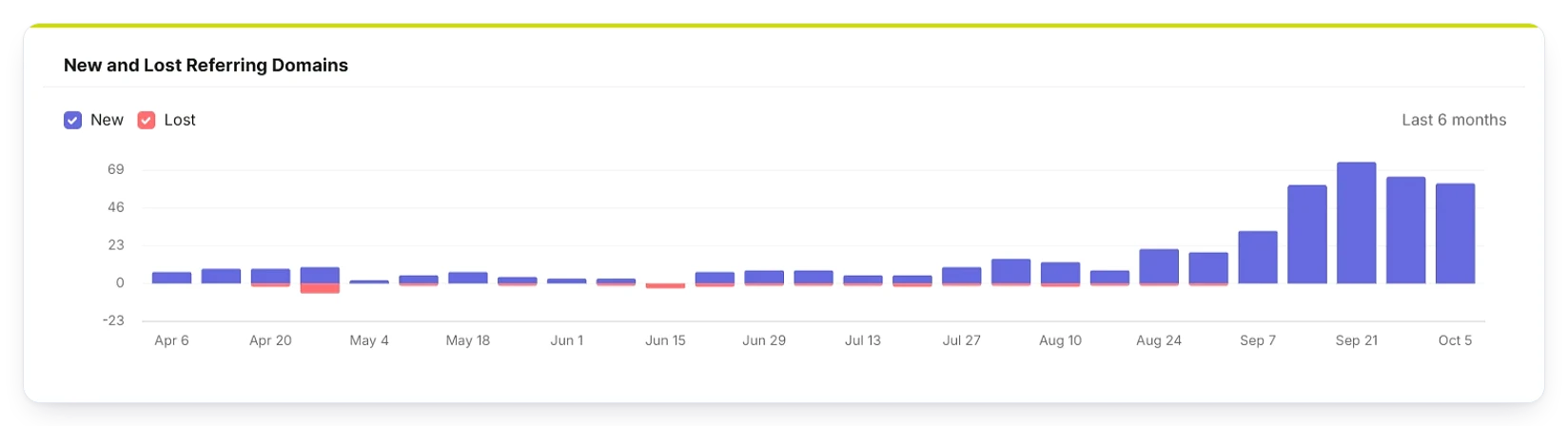
We focused on building a relevant, geographically aligned backlink profile rather than pursuing link volume for its own sake. Because the business serves a defined local market, we prioritized links that strengthened topical authority and local relevance while avoiding low-quality link farms, PBNs, and sites with little connection to the business’s target market.
Our approach combined several link acquisition channels:
- Local and industry directories: We used platforms such as Yelp, Yell, Houzz, Thumbtack, and other relevant directories to strengthen the business’s local presence and create additional discovery points. We treated these placements as more than backlinks; they also supported brand visibility, business preference, and opportunities to generate direct referral leads.
- Local PR and content placements: We targeted Washington, Bellevue, and Eastside-focused forums and content publications for relevant guest contributions and PR opportunities. The objective was to earn mentions from sources with genuine geographic or community relevance rather than generic publishing networks.
- Home improvement and flooring publications: We also secured placements on relevant home improvement and flooring blogs, linking to appropriate commercial and informational pages. This diversified the referring domains and anchor context while building topical relevance around flooring and home improvement.
The strategy focused on relevance, diversity, and natural authority growth rather than simply increasing the number of referring domains. This gave the website a backlink profile better aligned with the markets, topics, and customers it was actually trying to reach.
5. Google Business Profile Management
We treated both Google Business Profiles as key channels for calls, leads, showroom visits, and sales.
We optimized the profiles with the right primary and secondary categories, services, descriptions, hours, website links, and social profiles. We also created a twice-weekly GBP content calendar focused on before-and-after projects, work samples, and hyperlocal content to increase local visibility.
Alongside this, we built and optimized local citations across the Eastside and surrounding service areas, strengthening the business’s local presence and consistency across search platforms.
6. Technical SEO
Technical SEO was an ongoing part of the campaign, not a one-time cleanup. We continuously monitored and improved the site to maintain crawlability, indexation, page experience, and overall technical health as we introduced new pages, content, and structural changes.
We regularly addressed 4xx and 5xx errors, broken pages, redirect chains, and legacy URL paths, mapping redirects as needed to preserve existing value and guide users and crawlers to the right destinations. We also implemented and maintained schema markup across key pages while improving mobile usability and page-size performance.
Throughout the campaign, we used Google Search Console to monitor indexation, crawl behavior, page status, and emerging technical issues, allowing us to identify and resolve problems continuously rather than letting them accumulate.
This ongoing approach helped keep the technical foundation healthy as the website expanded and the SEO strategy evolved.
7. Website Speed & CWV
Website speed and Core Web Vitals were part of our ongoing weekly maintenance, while a dedicated optimization campaign delivered the biggest upfront performance gains.
Mobile
- Performance Score: 58 → 94
- LCP: 4.8s → 2.8s
- INP: 300ms → 86ms
Desktop
- Performance Score: 67 → 100
- LCP: 1.1s → 0.5s
- CLS: 0.028 → 0
We continued monitoring these metrics throughout the campaign to maintain performance as we added new pages, content, images, and functionality.

8. Reddit Organic Marketing
We used Reddit as an organic brand-building and search visibility channel, focusing on building awareness, earning trust, and creating additional opportunities for the brand to appear in traditional and AI-powered search.
Rather than promoting the business directly, we focused on genuinely helpful posts and comments that addressed real flooring questions and contributed to relevant discussions.
As a result, we earned visibility in SERPs for targeted flooring searches.
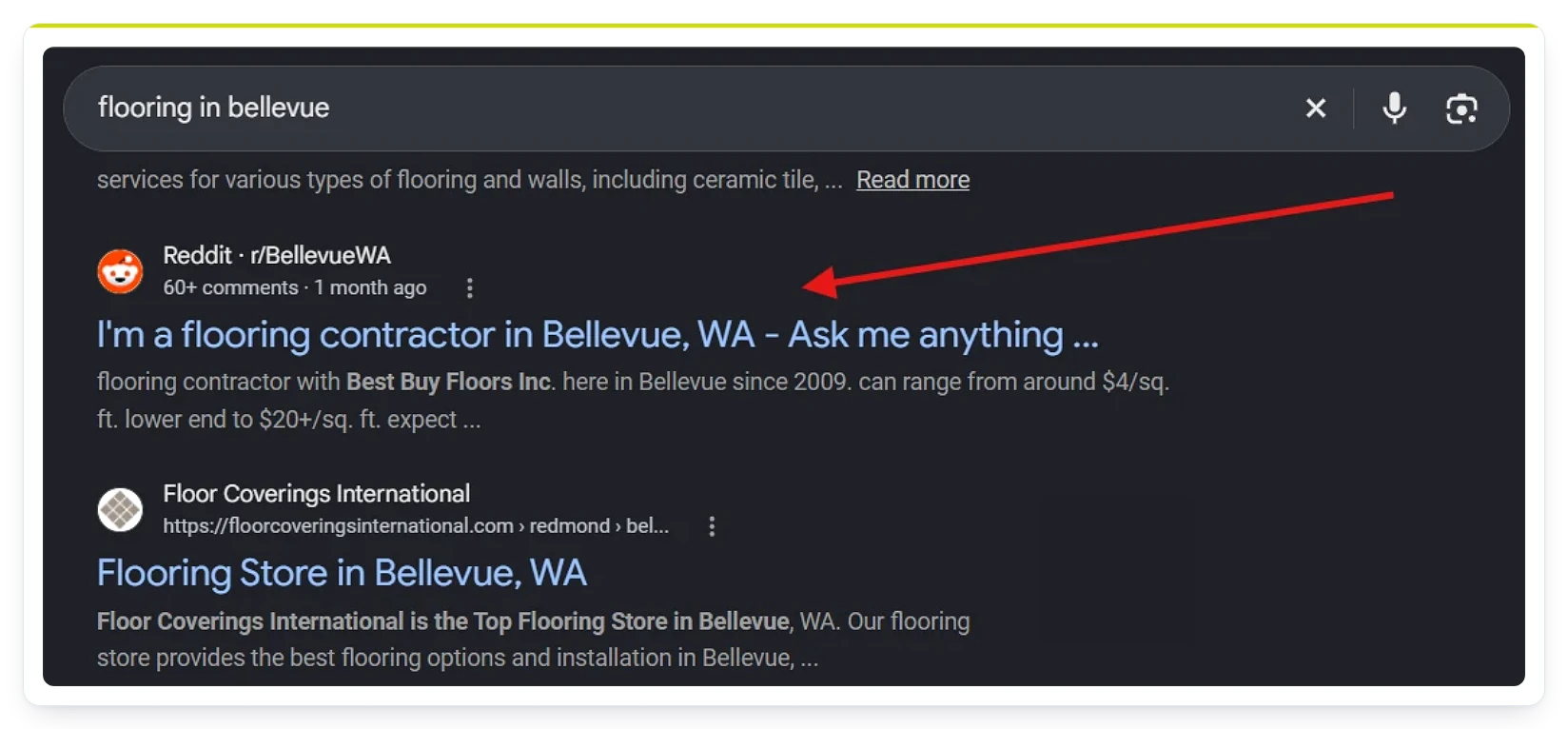
Turned relevant Reddit conversations into potential leads through helpful, non-promotional interactions.

The strategy was centered on contributing useful expertise first, with brand visibility and lead generation following naturally from those conversations.
Results
Search performance (full site, GSC data):

- Organic Clicks: 5.95K → 11.4K (+91.6% / 1.92X growth)
- Impressions: 1.04M → 987K (-5.1%)
- Average CTR: 0.6% → 1.2% (+100% / 2X)
- Average Position: 10.5 → 9.3 (1.2-position improvement)
Despite a slight decline in total impressions, the site generated 91.6% more organic clicks, coinciding with a 2X CTR improvement and stronger average rankings.
GA4 Traffic Acquisition
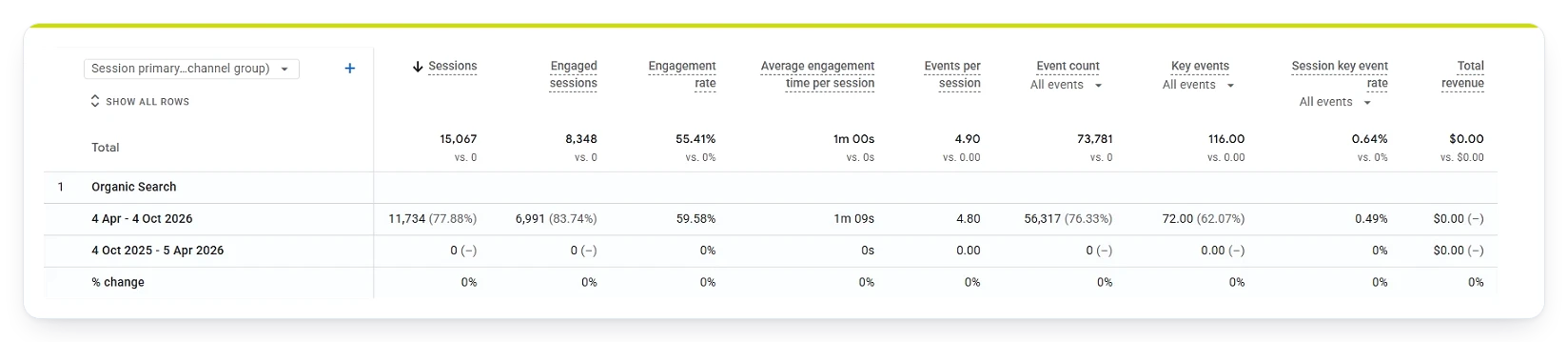
- Organic Search drove 11,734 sessions, accounting for 77.88% of total sessions.
- 6,991 engaged sessions, representing 83.74% of total engaged sessions.
- 59.58% engagement rate, indicating that a strong share of organic visitors actively engaged with the website.
- 1m 09s average engagement time per session.
Where the site ranks now

AI search visibility
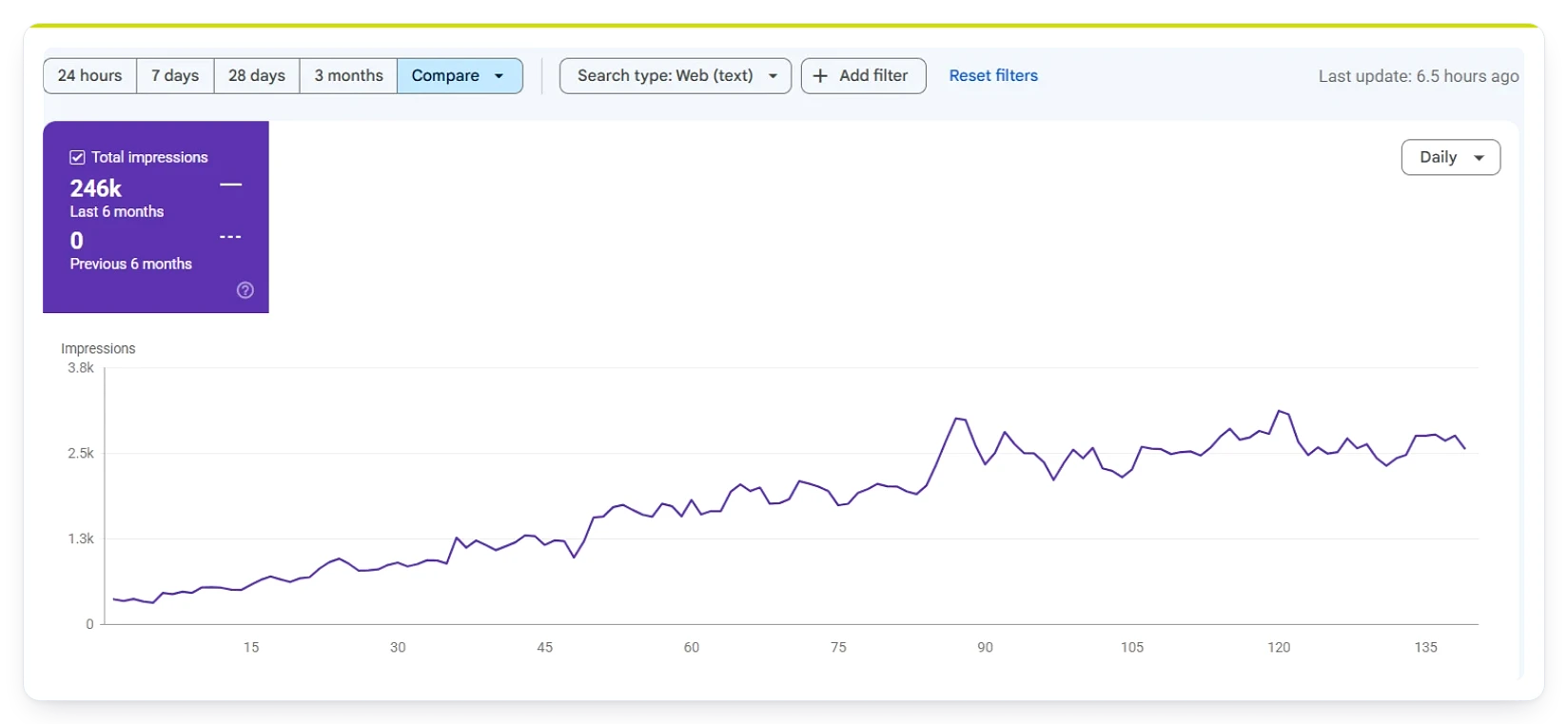
Generative AI:
- 246K Generative AI impressions recorded over the six-month period.
- Daily impressions: Increased from roughly 300/day at the beginning of the period to around 2.6K/day toward the end.
- Daily visibility: This represents approximately ~ 8.7X growth in daily Generative AI impressions from the start to the end of the period.
Microsoft Copilots & Partners AI Visibility
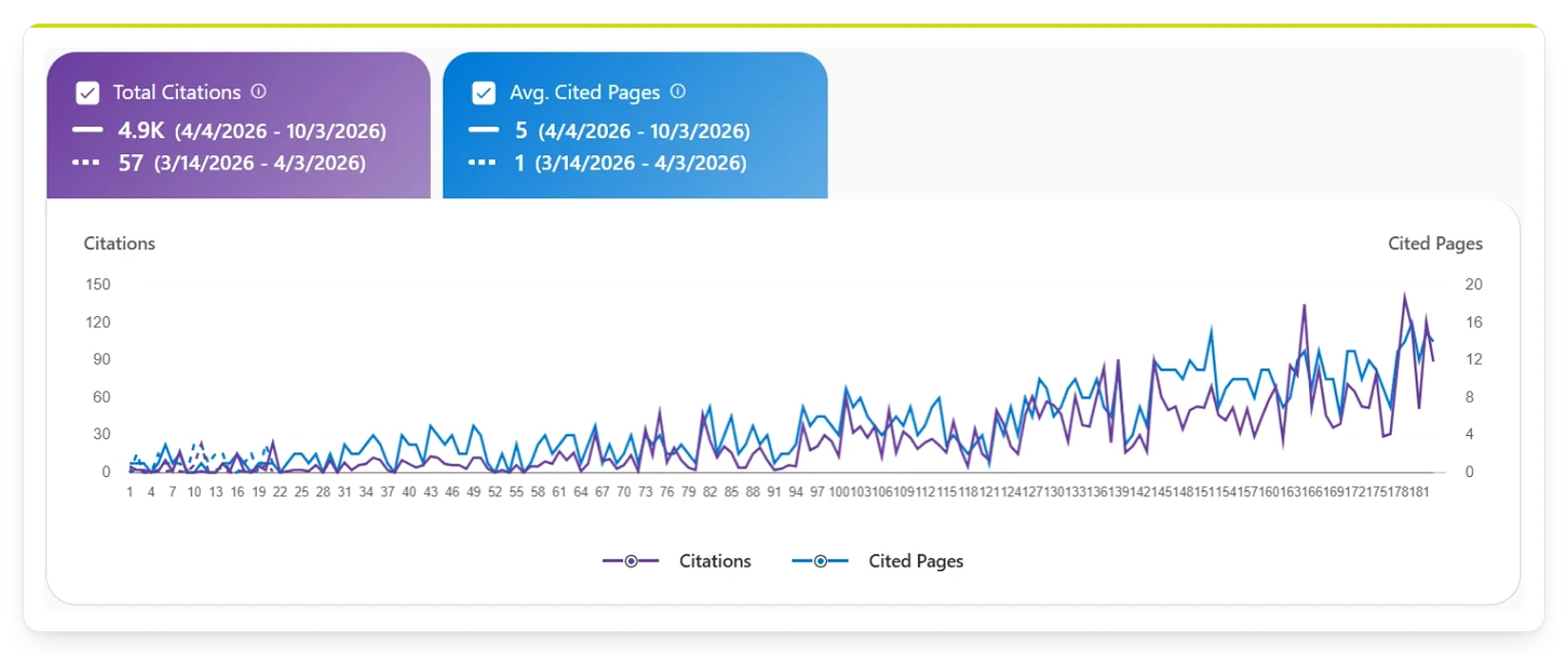
- 4.9K AI citations recorded from April–October 2026
- Average Cited Pages: 1 → 5 (+400% / 5X growth)
- Cited Pages: The average number of pages cited per AI response increased from 1 to 5, indicating more of the website’s content was surfacing as supporting sources.
AI citations increased from 57 to 4.9K, an 86X increase, while average cited pages grew from 1 to 5, expanding the website’s visibility across Microsoft Copilot and partner AI experiences.
Google Maps Performance


- 332 calls were generated across the Bellevue and Redmond GBP profiles from May–September 2026.
- Combined, the two profiles generated approximately 12% more calls than the same period in 2025.
- Bellevue: 290 calls, essentially stable year over year.
- Redmond: 42 calls, representing a 740% increase year over year.
Together, the Bellevue and Redmond GBP profiles generated 332 calls between May and September 2026, approximately 12% more than the combined volume during the same period in 2025.
ROI & Attribution
SEO Investment: $6,000 over 6 months
Measurable Return
- 11,734 organic sessions
- 332 Google Business Profile calls
- +91.6% organic clicks
- 2X organic CTR
- 4.9K AI citations
- 246K Generative AI impressions
Because the sales process happens primarily through phone calls, email conversations, showroom visits, measurements, and direct sales, there is no reliable way to attribute final revenue to a specific organic search interaction. Website purchases are not tracked as direct transactions.
What’s Next in the Strategy?
- Dominate the other service areas. In the current phase, we dominated the primary showroom location (Bellevue). Next, expand location coverage by building more location pages where the business operates.
- Extend what is winning AI Overview citations. Three reoptimized guides already earn them. Applying the same treatment to the remaining buying guides should add more.
- Reddit dominance. Leverage Reddit organic content strategy to dominate SERP and expand brand awareness.
- Google Ads & Lead Attribution Tracking. Launch Google Ads for prioritized services and products. Implement Call Tracking Metrics to measure lead quality and attribution.
Want Results Like This?
If homeowners in your area are searching for what you sell and finding your competitors first, we can help you close that gap. Book a strategy call, and we’ll show you what’s holding your organic search back.